
Understanding Continuous Wave Lasers vs Super Pulsed Lasers
I began using lasers in my clinic in 2017 and, since then, I have used six different laser therapy devices and treated hundreds of patients with them. During those years I have gained a lot of experience and knowledge that I want to share with you, to help you make an informed choice about which type of laser is appropriate for your clinical practice.
This discussion includes terminology and illustrations that are intended to be general in nature. Their usage here is informal and is not intended to equal the technical precision of a college physics course.
Section 1 - Understanding Waveform Diagrams
This introductory graphic shows 'time' on the horizontal axis and 'pulse power' on the vertical axis. One second of time is illustrated but that is not actual, real time. You may click anywhere over the animation to start and stop it.
The graphic simulates time with the grey vertical line segment that moves from left to right. If this movement represented reality then the line would continue moving beyond the graph's border, so this animation returns to its starting point and repeats the movement.
The top slider represents frequency, or repetition, in Hertz (Hz). The graph's axis along the bottom represents one second of time. If you move the frequency slider to 1 Hz, you will see one cycle (1 Hertz). A cycle is one laser light pulse that includes both its 'on' and 'off' time. Move it to 2, and you will see two cycles (2 Hz).
The middle slider controls the duty cycle. A duty cycle of 50% means the light is 'on' exactly as long as it is 'off'. A 10% duty cycle means that the light is 'on' for only 10% of the time, followed by 'off' for 90% of the time.
The bottom slider controls pulse power. This is the maximum power that the laser emits during the time its light is 'on'. 15 Watts (15 W) is typical for continuous wave therapy lasers.
The blinking red color represents the pulses of a laser, and its brightness is proportional to their power.
Section 2 - Understanding Continuous Wave Lasers
The vast majority of therapeutic lasers on the market are called "continuous wave" lasers. Although they have the word "continuous" in the name, the light they emit is actually pulsed on-and-off. To be technically more accurate, the term "continuous wave pulsed" lasers is better, but the industry refers to them as simply "continuous wave" lasers and I will use it here. Over the years I have used five different "continuous wave" laser systems in my clinic.
Looking at the waveform, you will see that the "continuous wave" laser is cycled on-and-off. Many therapy systems cycle the laser 10,000 to 20,000 times per second. The incredibly fast pulses of light, which our eyes cannot detect, are controlled by the laser's electronic circuits.
The waveform shows 8 of these pulses, with the zoom slider set at 100. Move the slider from 100 to 1 and you will see that the pulses are so numerous that they cannot be seen individually on the graph. Now move the zoom level back to 100 so you can see the individual pulses.
Move the second slider, called "Duty Cycle", and notice how the on/off time changes. The Duty Cycle can be varied on most laser therapy devices although some doctors may not change it from the manufacturer's default setting.
The third slider, "Pulse Power", determines the peak power of an individual pulse. For a single "continuous wave" therapy laser this is often 15 or 20 watts. The laser output of the entire "continuous wave" machine will be a higher total power if it has more than one laser.
Section 3 - Comparing Continuous Wave to Super Pulsed Waveforms
In this figure, the slider is at the left edge of its range so you see the continuous waveform we just discussed. Now move the slider to the right and notice how the pulses change. They are taller and narrower, becoming similar to a super pulsed laser waveform.
As the slider moves to the right, the total amount of energy delivered by each pulse remains the same. Here, "energy" is the capacity to do treatment. While the duty cycle decreased and the pulse power increased, only super pulsed lasers can simultaneously create both extremely brief and very powerful pulses.
To achieve greater depth of treatment the pulse power must be increased. Doing this adds more heat in the tissues, with each additional watt, unless the pulse 'on' time is shortened so that heat cannot build up to a level that causes discomfort.
Slowly move the slider to the right and notice that as you decrease the 'on' time, the pulse power goes up dramatically. This is what happens in a Lumix Q super pulsed laser. The energy that would have gone into heating tissue has instead gone into higher pulse power that can treat tissue that is deeper below the skin surface.
In a typical continuous wave therapy laser, decreasing its pulse 'on' time will not increase its pulse power due to limitations of the components in those devices.
Section 4 - Understanding Pulse Power and Average Power
In laser therapy there are two terms, Pulse Power and Average Power, that need to be discussed.
The figure shows 12 different pulse powers, yet each pulse has the same average power. In fact, the 7 pulses to the far right are so tall that they go off the graphics canvas that I am using to plot them. To see them, move the slider to the left to zoom out and see the tallest pulse on the far right. Notice how you then can no longer see the pulses on the left.
Looking at the first pulse on the left, it has a certain height and width. The pulse next to it has double the height and half the width. Each consecutive pulse is double the height and half the width of the prior pulse. However, they all have the same energy. If the first pulse actually represented 10 watts then the last pulse would be 20,480 watts, a multiplication factor of 2048 times the pulse power, yet the energy in each pulse would be identical.
The point is, why not have your laser be designed to produce much higher pulse powers yet keep the average powers to reasonable levels. It's like having your cake and eating it too. You can have both greater depth of treatment and low average power.
Heat is the enemy of laser therapy. If during treatment you have to be really careful to not stay in one spot too long due to heat build-up, laser therapy could become uncomfortable or possibly burn the skin. Lumix Q super pulse technology enables the laser to produce very high pulse power that will penetrate deeper into tissues, and still have safe average power that does not produce uncomfortable heat. It's a win/win combination that I have observed countless times, using Lumix Q lasers for treatments in my clinic.
Section 5 - Laser Parameters
The animation shows a laser head emitting photons of light, represented by white dots, that penetrate through the skin, then muscle, and possibly into bone. Experiment with the controls and notice the effects on the photons. Do they penetrate deeply or stay nearer to the surface? Do they spread out or are they concentrated? Is there more or less scattering at certain wavelengths? Relevant laser parameters are described here and how they relate to therapy treatments.
Pulse Power
The laser light's maximum power at any given time. This is directly related to a laser's depth of penetration into tissues. Most continuous wave therapy lasers produce 15 to 20 watts of penetrating pulse power, but the super pulsed Lumix Q laser can produce up to 132,000 watts of penetrating pulse power.
Average Power
The laser's mean power output over a period of time. It is the major factor in heat accumulation and is also related to how much treatment is achieved.
Lens Aperture
In a laser therapy device's optical system, it is the opening that limits light passing through it. The aperture may be wide (diffuse) or narrow (concentrated), and this affects the treatment area size.
Lens Distance
The distance from the therapy device's lens to the skin, which also relates to the treatment area size.
Wavelength
This is related to the color of visible light, red to violet, although wavelength applies equally to the entire spectrum of energy from radio waves, microwaves, infrared, visible light, ultraviolet, x-rays to gamma rays. Some wavelengths penetrate tissue better than others.
Section 5 - Understanding Wavelength
This figure shows the entire spectrum of light. We tend to think of light as just the light that we can see, but the entire spectrum is considered light, just different wavelengths of light and most of them are invisible.
There is a range of wavelengths that works really well for laser therapy. Therapy laser manufacturers design their products to produce certain specific visible and slightly infrared wavelengths.

Different wavelengths penetrate tissue to different depths. We think of light as just the visible spectrum, but even radio waves are considered light although we can’t see them. Visible or invisible, many wavelengths of light are useful.
Color refers only to what we see in the visible part of the spectrum, from red to violet. Although our eyes cannot see above or below these wavelengths, the invisible wavelengths have energy that can be used for other purposes.
For example, beyond the red is called infrared, which is invisible. Many therapy lasers produce infrared wavelengths so an additional low-power visible red laser is added to the device to assist the doctor in guiding the therapy beam. Some infrared wavelengths penetrate tissue more effectively than visible light.
Beyond the infrared are the far-infrared wavelengths, including body heat and far-infrared saunas. Unfortunately for us, even though a far-infrared sauna can penetrate deeply into tissue, it does not have enough energy per photon to trigger the chemical reactions needed to start-up ATP production in the body. And if clinical treatments using far-infrared wavelengths produced dramatic increases in ATP production then we would not need lasers because our own body heat would work to heal us.
We are left with a "sweet spot" for achieving depth of treatment in the 800 to 1100 nanometer wavelength range. This is just physics and physiology which cannot be changed. Radio waves and microwaves pass through tissue so they won’t work for our therapy. Ultraviolet doesn’t penetrate and it can damage tissue. X-Rays do create the ATP reactions we want but they also damage tissue. Red would be great if it could have deeper penetration, and green and violet light penetrate even less. So we're left with 800 to 1100 nanometer wavelengths, which gives us good depth of penetration plus sufficient electron volts of energy per photon to affect our physiology.
Electron Volts are basically the energy of a photon of visible or invisible light. The more energy per photon the more work it can do. Some photons are beneficial for laser therapy although most are not.
At the bottom of the figure there is a large range of photon energy values, ranging from 0.000000248 to 2,480,000 electron volts. If photon energy is too low the laser won't treat anything, while energy that's too high will damage tissue. Red light penetrates tissue better than violet although red light photons have lower energy. The unfortunate oddity of visible light is that the higher the energy per photon, the less it can penetrate tissue. The wavelengths commonly used in laser therapy consist of photons with about 1 to 3 electron volts of energy, which is safe for tissue and therapeutically effective.
Section 6 - Comparing LEDs to Lasers
LEDs (light emitting diodes) and lasers are very different. It is important to understand these differences because even though they both produce light, their light is physically different. It’s not that one is bad and the other is good; they simply have different uses.
You find LEDs everywhere: car headlights and taillights, computer monitors, flashlights, etc. They are an inexpensive source of light. You don’t use lasers as flashlights because they do not produce a diffuse white light source that lights up a room.
LED light is relatively broad spectrum while laser light is very narrow spectrum. The figure shows the small portion of the entire spectrum that is visible to our eyes. What you are seeing is a spectrogram, not a waveform like we previously showed. You can move the top slider, left and right, to visualize the difference of light produced by LEDs and lasers. With the top slider all the way to the left, you see a broad spectrum. With the top slider all the way to right, you see a narrow spectrum.
To visualize an LED, move the top slider all the way to the left and with the bottom slider move the dome-like shape towards the left side, but not all the way, so that you can still see the entire dome.
What you are seeing is the spectrogram of an LED. Notice it is not a pure shade of color. Instead, it is made up of many shades of visible light. The color at the center of the dome is the most powerful color and the colors on both sides of the center are less powerful. They fall to zero the further you go from the center peak. This broad spectrum, or broad color, light is typical of an LED regardless of its peak color.
Now without touching the bottom slider, move the top slider all the way to the right. And as you do, notice how the light source becomes less broad, until it becomes a “perfect” single color shown as a line. This narrow spectrum, or narrow color, light is produced by a therapy laser.
Section 6b - Comparing LEDs to Lasers
Red LED

Red Laser

Violet LED

Violet Laser

A therapy laser that produces power at one specific wavelength of light gives more depth of penetration than the broad spectrum of power produced by an LED. If we have a 1 watt laser versus a 1 watt LED that has a peak color identical to the laser, the laser’s single wavelength will penetrate further.
Another way to look at it is an LED ‘kinda’ consists of many, slightly different color, ‘lasers’; all with much lower power individually that, when grouped together, makes the dome-like shape in the spectrogram in the previous figure.
Another example I tell people: If you have 1 flashlight in your right hand that is 12 watts, and 3 flashlights in your left hand that are 4 watts each, which would better illuminate an object? It would be the single 12 watts flashlight. Which would illuminate a larger area? The 3 flashlights. It’s not that one is better than the other, they’re just different. LEDs are better for larger coverage area while lasers are better for penetration depth but are limited to a smaller area than LEDs.
Figure 7 shows the height of the LED and laser to be the same. However, if they were the same power, the height of the laser line would be considerably higher than the peak color’s height of the LED dome.
Section 7 - Full Spectrum
LED’s and Lasers are very different. It is important to understand these differences, however, because even though they both put out light, the light is physically different. It’s not that one is bad and the other is good; they simply have different uses.
You find LED’s everywhere from a cars headlights and taillights, computer monitors, flashlights, etc. They are an inexpensive source of light.
Section 8 - Understanding Pulse Power and Average Power
Understanding Pulse Power and Average Power
This figure shows the spectrum of a typical LED with the slider all the way to the left. As you move the slider to the right it becomes more and more "like" a laser with its power compressed into a single wavelength. Notice how the peak wavelength's power jumps dramatically from 17.1% (LED) to 100% (laser). This is one of the main reasons why lasers are better for deeper tissue penetration while LEDs are better for surface coverage area.
What I have done here is divide the area underneath the dome into vertical slices and measured the area of each slice compared to the total area below the curve. This allows a percentage of total power to be calculated and shown for each vertical slice. The sum of all percentages in the graph is 100%.
We start with an LED spectrogram and transition towards the laser spectrogram. There is no device that functions in-between these two; it is either an LED or a laser. Because they are different designs, the light produced by one cannot be changed to the other and neither can be used for both purposes. Laser diodes are not LEDs even though the word, diode, appears in the name of both.
As you compress the dome by moving the slider to the right, the off-center power compresses into the peak of the curve that then gives it higher power.
The spectrogram of a laser is just a thin line because a laser produces a specific wavelength of light. However, the dome of the LED spectrogram is many wavelengths that our brain combines into, what seems to us, a single color.
This is the best way I could think of to illustrate how LED light differs from laser light. Each type of light is better suited for certain treatments than the other. Not that one is better than the other, they are just different.
Section 6 - Comparing Continuous Wave to Super Pulsed lasers
Look at the differences between the two types of pulses delivered by two very different laser therapy devices.
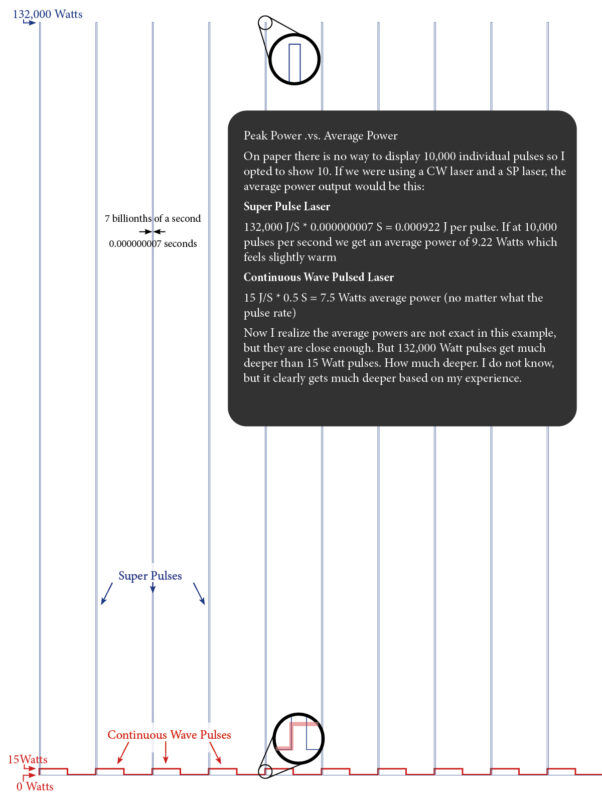
In blue, the super pulsed pulses are incredibly high. So high in fact that if they were drawn proportionally to the red, continuous wave, pulses at the bottom then the blue pulses might go above the roof that you may be under right now. These pulses are very high power, but are on for only a few billions of a second. The pulses turn on-and-off so fast that the heat they produce is small.
How can this be done? And why aren't other laser manufacturers doing the same thing?
There are many different ways to produce laser light.
Laser diodes are the most common method, and they are used in most continuous wave therapy lasers. Laser diodes work well and are relatively inexpensive. They are produced in a wide range of power levels and some, for example, are used in low power laser pointers.
Another method is Neodynium:YAG (Nd:YAG) lasers, which are less commonly used for therapy and are usually more expensive than laser diode systems. The advantage of Nd:YAG therapy lasers is that their light can switch on-and-off one thousand times faster than most therapy laser diodes, which enables the Nd:YAG laser's pulse power to be 1000x higher.
Let's say, for example, you have a continuous wave laser diode therapy system producing 15 watts of pulse power and 10,000 pulses per second. A Nd:YAG therapy system can produce 15,000 watts of pulse power and 10,000 pulses per second with no increase in average power.
Laser diodes used for therapy simply cannot do this. They turn on-and-off in millionths of a second, but Nd:YAG therapy lasers turn on-and-off in billionths of a second. It's simply a difference in technology. For more information you can search Google for details of how this happens, but this presentation should be enough to highlight the differences between laser diode and Nd:YAG technologies.
Conclusion
I hope you have found this page helpful in understanding laser technology and the different types of laser therapy systems that are available. All lasers do something, and you need to be sure that you know what 'something' you want to accomplish. If you have read a variety of laser and laser therapy webpages then you will be able to talk to laser sales people with more confidence. If you have any questions, please feel free to contact me at the number on this website.