


The Lumix Q Super Pulsed Laser
I've gone through a number of lasers since 2017. I find something better, buy it, then sell the old ones.
Is there a difference in laser systems? For many doctors, I believe the answer is no. Do they think patients won’t notice the difference as long as the technology uses lasers? This is unfortunate, but it is what it is, as they say. Here I will go into details that you won’t hear anywhere else.
In 1991, I graduated with a degree in electrical and computer engineering. Now I am a chiropractor. My previous degree gives me an advantage in understanding the unfamiliar lingo used in laser technology.
I hope to explain this to you in a way that makes it understandable so you can make better decisions if you want to incorporate laser therapy into your practice. I must warn you, however, I am biased towards the Lumix Q because of what it can accomplish.
To explain this, however, I need to explain the typical laser technology that you will see in the profession. Trying to teach this on a website will be interesting. I have made several YouTube videos that explain things very well. They’re fun and engaging, and people have given me great feedback about these videos. They typically say, “I get it now. I couldn’t repeat it back, but I get it.” Let’s get started.
Videos Playlist. Or, if you prefer to read, scroll down.

Understanding Continuous Wave Lasers used in Laser Therapy
There are 4 videos in this series. Afterwards, you will know much more than your typical salesperson. If you are interested in buying a laser, taking a little time to watch these might save you a good chunk of money, time, and hassle. This is the first video. Afterwards, watch the videos below.


Why do Laser Manufacturers use Different Wavelengths?
Different wavelengths penetrate tissue differently. We think of light as just the visible spectrum, but even radio waves are still considered light; we just can’t see them. The different wavelengths of light can be used for different purposes.
Color refers only to what we see in the visible part of the spectrum, from red to violet. Even though we cannot see above or below these wavelengths with our eyes, there is still activity there.
If we move farther from violet, we enter the ultraviolet (black light, suntanning rays). Above that, we enter the X-ray wavelength range. On the other side of the spectrum, beyond the red, it is called infra-red. Many lasers use infrared wavelengths. You cannot see the light directly, so an additional low-power red laser is added to the beam to help you see where you are aiming. Infrared wavelengths have the unique property of penetrating human tissue more effectively.
If you keep going past the infrared, you enter the far-infrared wavelengths. These are the wavelengths of body heat and those of far-infrared saunas. If you have ever watched a “Searching for Big Foot” TV show, you have seen them using far-infrared cameras to detect living creatures’ body heat. Body heat can be detected over long distances in pitch-black conditions using special cameras, as shown below.
Unfortunately for us, far-infrared wavelengths do not have the therapeutic effects we are looking for. Oh, do I wish they did. Even though a far-infrared sauna can penetrate deeply into a person, it simply does not have enough energy per photon to trigger the chemical reactions needed to jump-start ATP production in the body. And if far-infrared wavelengths healed, we would not need lasers, because our own body heat would heal us.

We are left with a sweet spot for achieving depth of treatment in the 800 to 1100 nanometer wavelength range. This is just physics. It cannot be changed, no matter what the marketing says. Radio waves pass right through you, and so do microwaves, but they won’t work for our purpose. Ultraviolet doesn’t penetrate, so that won’t work, plus it can damage tissue. X-Rays do create the reactions we’re looking for and penetrate really well, but they also cause damage. Red would be great if it could get the penetration, but it cannot. And green and violet even less so. So 800 to 1100 nanometers it is. With this, we get good depth of penetration and enough electron volts per photon to affect our physiology.
How is Power Measured in Laser Therapy?
Don't let the image following the text intimidate you. Once you hear the explanation, the image will make total sense.
Power is measured in joules per second. What is a Joule? It is simply a measure of energy that you can learn more about if you choose, but it is not necessary. Let’s take an example that most of you will be familiar with: the hundred-watt light bulb.
Many of us grew up with 100-watt light bulbs. Forget about the LED bulbs we have today. Go back 20 years and reminisce. Do you remember them giving off a good amount of light? How about heat?
A hundred-watt light bulb uses 100 Joules of energy every second that it is on. It uses 0 Joules of energy when it is off. That is all you need to know. We can all relate to this easy but accurate explanation.
The formula is: 1 Watt = 1 Joule/Second, or, in our light-bulb case, 100 Watts = 100 Joules/Second.
Let’s say your hand is on the light switch, and you turn the light on for half a second, then off for half a second. How much energy in Joules did the light consume? Well, it took 100 Joules per second, but for only half a second, which would be 50 Joules. Then it was off for half a second, which took no energy at all. So 50 J + 0 J = 50 J of energy used over the entire second. (Shown in Image A below)
What about the waveform in Image B? How much energy is consumed here? 25J for the first quarter of a second. 0J for the second quarter of a second. 25J for the third quarter of a second and 0J for the 4th quarter of a second. 25J+0J+25J+0J = 50J. Again, we get the same total energy used every second as in the prior example. You will also see that for all the other examples, the total energy consumed is the same, even if the laser is pulsing at 50kHz (50,000 cycles/second).
This is the nature of Continuous Wave Pulsed lasers. All of these waveforms consume 50 Joules of energy per second, whether we are talking about a hundred-watt light bulb or a hundred-watt laser. The takeaway is that a 100 Watt (or Joules per second) device pulsed on and off equally delivers 50 Joules of energy per second. It is really important to understand the implications of this. In laser jargon, the pulse power would be 100 joules. The average power would be 50 Joules per second, or half the pulse power. It is this annoying fact that really limits the pulse powers that can be used with continuous-wave pulsed lasers.
Why does this matter? Heat!!! It is all about the heat. With laser therapy, heat is the enemy. It prevents higher pulse powers in the 15 to 20-watt range per laser. However, a laser can only penetrate as much as its pulse power allows. In this example, we used the simple 100-watt light bulb (50-watt average). For humans, an average of 50 watts is too much power because of the heat produced on the skin and in deeper tissues, given its CW-pulsed operation.
Super Pulsed lasers get around this problem with a “trick of physics”, which I’ll explain shortly. Now that you have seen how CW Pulsed lasers work to some degree, understanding Super Pulsed lasers will be easier to grasp.

Super Pulse Lasers
When I first heard this term, I thought it was a marketing ploy, but it is a real thing and will overtake the laser market at some point, in my opinion. S uper pulsed lasers allow much deeper tissue penetration with much less heat by exploiting a simple physical effect. Just look at the waveform of a super pulsed (SP) laser and see if you can tell the difference from a CW pulsed laser.
What is the difference? Well, it is not on and off equally like the CW pulsed laser. Additionally, the pulses are much narrower and taller. Why is this absolutely brilliant? You can use much higher pulse powers without all the heat accumulation on the patient. As I said earlier, peak powers are limited with CW pulsed lasers, but with SP lasers, they can reach 132,000 watts. That is crazy, you say? What is even crazier is that the average output power can be as low as 9 watts, which is very tolerable for a person or animal.
Super pulsed lasers must switch on and off very quickly to achieve pulses this narrow. The pulses are on for only a few billionths of a second and then off for very long relative times. Remember, with the CW Pulsed lasers, we summed the energy over the first quarter of a second, and it was 25 Joules. Well, for comparison’s sake, each pulse of an SP laser is in the microjoule range, or millionths of a Joule. These are completely different technologies, but they are still lasers. (Granted, I’m not taking into account the frequency here, so this is not a perfect comparison.)
Comparison of Super Pulse and Continuous Wave
You can see that the waveforms to the right are completely different. The vertical axis is also not to scale. If it were, the tops of the super pulses would reach past your ceiling, where you are reading this right now. But you get the point. A person cannot feel these individual pulses. It is not prickly. They are on for such a short time that they cannot be felt. When they are added together, a person feels the heat energy from them, but it is experienced as warmth, no different from a heating pad.
The 7 billionth of a second is also not to scale. I wanted you to see that these were on-and-off pulses, so I made them narrow but not so narrow that they wouldn’t be visible in print.
It is important to understand that most lasers on the market are continuous-wave pulsed lasers, and that the average power is always half the pulse power.
By definition, a super pulsed laser must have a pulse power 10x the average power. With 132,000 watts of pulse power and 9.22 Watts average, this definitely qualifies as a super pulse. Even if it were only 1000-watt pulse power and 20-watt average, this would qualify. Or 110-watt pulse power with 0.5 watts average. A 15-watt pulse power with a 7.5-watt average is not a super pulsed laser. So continuous wave pulsed lasers are definitely not super pulsed, since their pulse powers are only 2x the average power.
Now, granted, some parameters in a CW pulsed laser can be adjusted to achieve much lower average powers, but the point is that their pulse powers are, by design, low. Usually, only 15 watts of peak power per laser.

How to Choose Your Pulse Power
When I first got my Lumix Q, I set it to its highest pulse power of 132,000 watts (132 kW), which defaults to an average output of 9.2 watts just by setting the frequency to 10kHz. I was like, ” Deeper is better, so why not use this setting for everything?” But I have learned that this is not always the best way of treating.
In this section, I will discuss the advantages of lower pulse powers. Not down to levels of today’s common lasers, but to say 10kWatt, 41kWatt, or 72kWatt pulse powers, for example.
Looking at the settings below, notice that as frequency increases, pulse power decreases and average power increases by default. These parameters are not directly set by you, the user. They are preprogrammed into the machine.
What you have control of is the frequency of the pulses, i.e., how many pulses per second. This single number automatically changes the major parameters. There are two other controls called duty cycle and power level that I do not have to touch very often, so for the moment, let’s forgo discussing them as they are easy to understand. We will leave both at 100%, which I usually do unless I’m treating an angry nerve in the face, for example.
There are two power levels to consider. The pulse power determines how deeply photons penetrate tissue, and the average power determines how many photons come out of the laser head and therefore how much ‘work’ you actually get done.
Let’s say we have three Lumix Q devices, each with its laser head pointed at the thigh (shown below), and with different frequencies for each.
At first glance, you might think option 1 is better because it goes deeper, but the machine can only deliver 9.2 Watts of average power at this setting. Yes, we are going deeper, but the 9.2 Watts is being spread out through a much thicker piece of tissue, AND we are getting fewer photons out of the machine.
Option 2 is not getting as deep, granted, but it is putting out significantly more average power, and that power is not spread out as much, resulting in faster treatment in the outer layers of tissue.
Option 3 is getting even less deep, but it is putting out 20.2 watts of average power even though it is not treating as deep.
There is nothing wrong with the first set of parameters, but you would have to treat longer.
Hopefully, this helps in understanding the difference between pulse power and average power.


The Lumix Q’s parameters are mostly controlled through the frequency, but it is the pulse power that determines the depth, not the frequency. This becomes clearer when you look at the actual pulses. The more pulses you have (the higher the frequency), the less pulse power there can be in each pulse to keep the average powers reasonable.
The other two controls, duty cycle and output power, give you finer control over your average power. For example, let’s say you chose 40kHz to give you 27 kWatt pulses, but you needed only 1.8 watts instead of the full 18.2 watts. Setting your duty cycle number to 10% would give you that value. Plenty of control for exact treatment protocols.
The other huge takeaway is this: Typical lasers on the market heat tissue much faster than super pulse lasers because they don’t penetrate as deeply, spreading the energy. Remember, heat is the enemy of laser therapy. Yet heat is a part of any energy transaction. Just look at your car engine. Heat is a byproduct of the internal combustion engine to propel your car forward. Combating the heat requires a radiator, hoses, and fluid to move the heat away from the engine. It cannot be avoided.
Just like the engine, laser therapy has a similar problem. Heat is part of the reaction of putting energy, in the form of light, into the body. It cannot be avoided. Either use less powerful lasers or spread the laser energy further into the tissues.
The point is that super-pulse lasers heat tissue less than conventional continuous-wave lasers.
How do Lasers Work?
Lasers work by emitting photons of light. I liken them to particles, even though they exhibit both wave-like and particle-like properties. The photons do the work we are trying to accomplish by interacting with the Cytochrome C Oxidase enzymes in our mitochondria. If the photons cannot get past the skin, what good are they if we are trying to treat deep muscle tightness and pain? Super pulsed lasers get much deeper. How much, you ask? I do not know, but they do get deep enough to affect anything I’ve ever had to get to. In the image below, you can see an illustrative comparison of a CW pulsed laser on the left and a SP laser on the right. High pulse powers on for billionths of a second make this possible. This is the trick of physics I was referring to.
In my opinion, all laser therapy systems should eventually go to super pulse. The reason is that they work better, and the public needs to know the potential of lasers, and I do not think they are that impressed with the laser systems currently in use.
What About Safety?
When I first heard about these super pulse lasers, I immediately questioned the safety. How can a laser with such high power be safe? I did a little research, asked a few questions, and realized they are really, really safe. In fact, lower-power CW lasers can pose a greater safety risk. Being a chiropractor and an electrical engineer helped me realize why. Then I asked the developer, and he confirmed what I believed.
All lasers require absolute “fail-safe” mechanisms to meet FDA safety requirements. If a pulse became “stuck” in the ON position and exceeded its designed pulse duration, the laser emission cuts off, whether in CW or SP lasers. The real safety of super pulse lasers lies in the lack of thermal buildup from the extremely short pulses, followed by the relatively long non-thermal “relax” phase.
The super pulsed laser pulse widths of Lumix lasers are a maximum of 70 billionths of a second long. Compare that to the CW pulse widths of milliseconds or thousandths of a second long. Shorter bursts are safer. A super pulse laser can ONLY produce high pulse energies for extremely brief periods. Exceed those short pulse durations, and it simply stops working with no harm to anyone. If the circuitry failed somehow, all you might notice is that the gentle warmth of the laser treatment would stop.
Is Laser Therapy Scary to Learn?
Simply put, laser therapy is as scary to learn as teaching your kids how to use a steak knife for the first time. I’m not kidding. When doctors are in my office, I put the laser on full power and let them work on themselves. Five to ten minutes later, they are comfortable with the process and are asking more questions.
Lasers are easy to use, but just like that little bit of trepidation you have when your kid picks up the steak knife for the first time, that is how you will feel when you are holding the laser head for the first time. It is a short-lived fear. Then you will get to work on the problem you are trying to fix in yourself. Then, a few days later, you are asking how you can get one and how much they cost.
Practice on yourself when you first get your laser. Do not practice on your patients right away. Even if it is just 10 minutes on yourself, learn what it feels like and how fast you have to move around, etc. I remember when I gave my first adjustment. It was a simple thoracic adjustment, but I was terrified. Everyone around me was like, “Just push!!!” Afterwards, I realized it was not such a big deal.
If you are extra nervous, start at a low power and work your way up. There is nothing wrong with being conservative with your laser settings.
How do I treat the spine?
In school I learned motion palpation techniques and used that in practice for many years. I know all chiropractors learn motion palpation to some degree, but we all know that when vertebrae are locked together, it is not a good thing.
When I have patients prone, I feel for the stuck and rigid areas of the spine that, in the past, I would adjust to try to loosen. Using the Lumix Q, I apply the laser to the spine where it is stuck, and the vertebrae start to loosen up. It is either tight muscles or tight ligaments that are seizing the vertebrae together, and the laser loosens both simultaneously. It cannot overloosen them, so there is no need to be concerned about that.
This is one way I use the laser in my office. Of course, laser therapy can be used on any tight muscle or ligament that you can find. I bet you are thinking about where you would like to try it on yourself right now. Maybe on an ache or pain you have had for a long time, and nothing seems to work on resolving it.
Laser Therapy is About to be in High Demand!!!
People are starting to question general medicine, and distrust is building. What will people do if they cannot trust the medical industry? Who will they turn to? It will be chiropractors, physical therapists, nurses, and medical doctors who take more natural approaches with fewer drugs and surgery.
Lasers are a huge part of the solution because they address the underlying chemical problems in the muscles, ligaments, and tendons that are causing pain. Yes, adjusting can give amazing results, but I have found it does little to loosen tight muscles, so you have to adjust over and over.
Exercises and stretches do not get to the root cause of muscle tightness either. Medications have side effects and do not usually get to the root cause of problems. And as necessary as surgery can be at times, it often does not solve problems either, and can easily increase pain and dysfunction.
Lasers, on the other hand, are very safe and very effective, provided you can reach your target tissues.
Lasers are not very well known at this point, but now is the time to learn how they work and how to use them.
Introducing the Lumix Q Laser
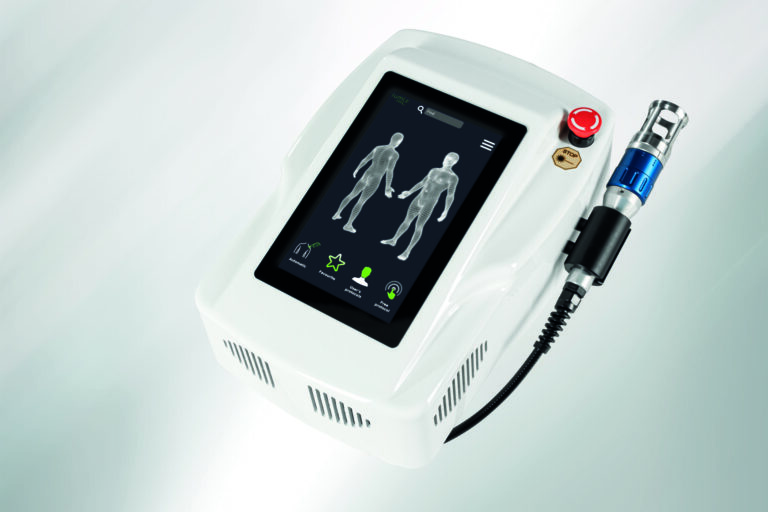
I know it looks like just another laser, but it is special. You have to try it. The controls on the Lumix Q are the easiest I have seen. By changing just the frequency, the other parameters are adjusted automatically, making it very simple to operate.
My most common setting on the Lumix Q is 72kW pulses (72,000W) and 14Watt average power. I find that 72kW pulses get as deep as I usually need, plus I get a really nice average power. Perfect for most areas I treat. And there are no click fees, unlike with other laser manufacturers.
The picture makes it look smaller than it is. If you watch some of the videos where I am treating myself or someone else, you will see the true size of it.
Congratulations
If you made it this far, you were truly serious about learning laser fundamentals.
If you have any questions about the operation of this laser, its uses, or its cost, please give me a call at my office.